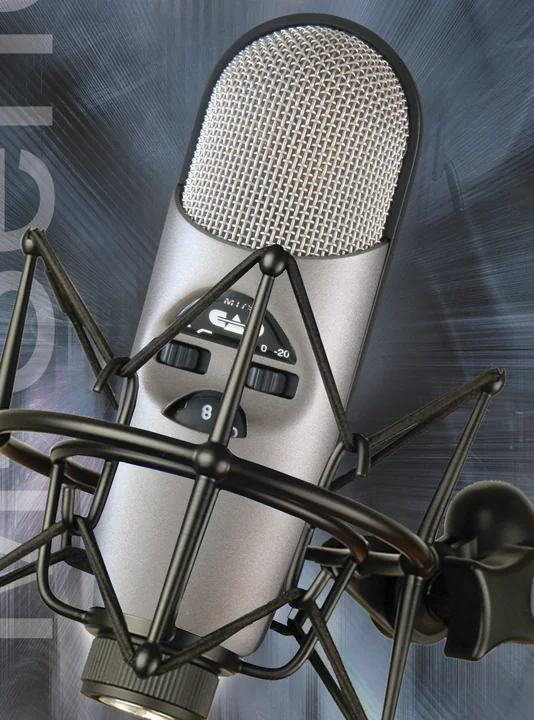
CAD Audio
CAD M179
Large dual-diaphragm condenser, continuously variable pattern (omni to figure-8, cardioid detent), transformerless, with pad and high-pass filter
Approximate Some readings for this mic are uncertain; see the graphs.
- Type
- Condenser
- Pattern
- Omni / wide cardioid / cardioid / hypercardioid / figure-8
- Sensitivity
- −36 dBV/Pa
- Self-noise
- 11 dB(A)
- Max SPL
- 143 dB SPL
- Impedance
- 200 Ω
- Rated range
- 10 – 20k Hz
Frequency response: from the spec sheet (Recording Hacks copy), p. 2. "Cardioid", "Figure 8", "Omni" graphs; relative dB ("RESPONSE IN dB"), the line near 0 dB at 1 kHz. Distance, room, smoothing and switch settings not stated.
Dashed: outside the rated range, or simulated (other angles and distances). Hover or tap the graphs for values.
Polar pattern
Polar pattern: from the spec sheet (Recording Hacks copy), p. 2. "card" polar; 5 dB per ring, rings labelled -5 to -25, 0 dB at the outer ring. Each half shows different frequencies: left 100 Hz, 500 Hz, 1 kHz; right 5, 10, 15 kHz. Approximate reading error up to about 1 dB.
All specs
| From the spec sheet | ||
|---|---|---|
| Capsule | 1.1-inch dual diaphragm, gold-sputtered, externally biased; the dual-pattern version of the Equitek E-300 capsule. "the dual pattern version of the original equitek e-300 capsule, an externally biased capsule with a gold sputtered 1.1" diaphragm"; "Large 1.1" dual diaphragm external bias condenser capsule". | p. 2 |
| Sensitivity | −36 dBV/Pa (16 mV/Pa). "-36 dBV (16mV) @ 1Pa". The 2001 manual: "-56 dB (0 dB = 1 volt per microbar). 15.9 mV/Pascal." Pattern not stated. | |
| Self-noise | 11 dB(A). "Equivalent Noise Level: 11 dB-A". Pattern not stated. | |
| Max SPL | 143 dB SPL, pad on. "143 dB SPL (with pad)". No figure without the pad. | |
| Output impedance | 200 ohm. "200 ohms"; the 2001 manual: "Low (200 ohms nominal)". Transformerless balanced output. | |
| Rated frequency range | 10 Hz to 20 kHz. Printed "10-20 kHz" (both documents); the graphs run from 10 Hz. No tolerance given. | |
| Powering | phantom 24-52 V, at least 8 mA. "Minimum requirements are 24-52V phantom power capable of delivering at least 8 mA." The 2001 manual: "24, 48 Volt Phantom Power". | |
| Current draw | 8 mA, the supply must deliver at least this | |
| Low cut | flat, 100 Hz; 100 Hz; 6 dB/octave. "6dB/Octave @ 100Hz high-pass filter"; "Right position = Low end roll off below 100 Hz. Left Position = Flat low end response." Not graphed. | |
| Pad | −20 dB. "20 dB non-capacitive pad"; switch positions "0dB" and "-20dB". | |
| Connector | XLR-3 male. "Three pin male XLR type." | |
| Weight | 506 g, net. "17.8 oz. (506 grams)". | |
| Dimensions | 177.8 × 57.2 mm. "2.25" (57.2 mm) Dia., x 7.00" (177.8 mm) High"; height and diameter. The drawing gives 6 11/16 in. | |
| Finish | Charcoal grey urethane, satin nickel-plated front and rear screen. "Durable charcoal gray urethane. Satin nickle plated front & rear screen." The 2001 manual: "Black urethane front & rear screen". | |
| Supplied accessories | MZM-5 elastic suspension shock mount. "Furnished Accessories". Optional: 40-350 (50 ft), 40-351 (100 ft) and 40-352 (25 ft) extension cables. | |
| Total harmonic distortion | Less than 0.15% | |
| Electronics | Laser-trimmed op-amps instead of discrete FETs, with a large amount of negative feedback; transformerless balanced output | |
| Pop filter | Internal stainless steel pop/EMI filter | |
| Pattern control | Rotary knob ("360° Variable Pattern") with a centre detent at cardioid | |
| From the manual (Recording Hacks copy) | ||
| Dynamic range | 133 dB. "Dynamic Range: 133 dB." Only in the 2001 manual. | p. 3 |
Documents
- M179 Variable Pattern Externally Biased Condenser Microphone, User Manual / Specification Sheet ("M179_spec_0305_small")
- M179 User Manual / Specification Sheet
- M179 Variable Pattern Condenser Microphone (manual, 2001)
Copies kept by Mic Archive, because manufacturers move and drop their documents. Each is © CAD Audio, unchanged, with its original address.
Other mics
- AEA KU4
- AEA N22
- AEA N8
- AEA R44
- AEA R84
- AEA R88
- AEA R92
- AKG C 1000 S
- AKG C 12
- AKG C 12 VR
- AKG C 391 B
- AKG C 451 E
- AKG C 480 B ULS
- AKG C 535 EB
- AKG C214
- AKG C3000
- AKG C414 B-ULS
- AKG C414 XLII
- AKG C414 XLS
- AKG C451 B
- AKG C519 M
- AKG C636
- AKG D 12
- AKG D 20 B
- AKG D112
- AKG D40
- AKG D5
- AKG D7
- AKG P170
- AKG P220
- AKG P420
- Aston Origin
- Aston Spirit
- Aston Starlight
- Audio-Technica AE2500
- Audio-Technica AE4100
- Audio-Technica AE5100
- Audio-Technica AT2010
- Audio-Technica AT2020
- Audio-Technica AT2021
- Audio-Technica AT2031
- Audio-Technica AT2035
- Audio-Technica AT2040
- Audio-Technica AT2050
- Audio-Technica AT4021
- Audio-Technica AT4022
- Audio-Technica AT4033/CL
- Audio-Technica AT4040
- Audio-Technica AT4041
- Audio-Technica AT4047/SV
- Audio-Technica AT4050
- Audio-Technica AT4051b
- Audio-Technica AT4053b
- Audio-Technica AT4060
- Audio-Technica AT4080
- Audio-Technica AT5045
- Audio-Technica AT831b
- Audio-Technica ATM230
- Audio-Technica ATM25
- Audio-Technica ATM350
- Audio-Technica ATM450
- Audio-Technica ATM650
- Audio-Technica ES933
- Audio-Technica PRO 35
- Audio-Technica PRO 45
- Audio-Technica U853
- Audix ADX20i
- Audix D2
- Audix D4
- Audix D6
- Audix f6
- Audix FireBall
- Audix i5
- Audix MB5050
- Audix MB8450
- Audix OM5
- Audix OM7
- Austrian Audio OC16
- Austrian Audio OC18
- Austrian Audio OC818
- Austrian Audio OD303
- Avantone CK-1
- Avantone CV-28
- Behringer C-2
- Behringer ECM8000
- Behringer XM8500
- beyerdynamic M 130
- beyerdynamic M 160
- beyerdynamic M 201
- beyerdynamic M 260
- beyerdynamic M 380
- beyerdynamic M 422
- beyerdynamic M 69 TG
- beyerdynamic M 88 TG
- beyerdynamic M 99
- beyerdynamic MC 740
- beyerdynamic MC 834
- beyerdynamic MC 930
- beyerdynamic Opus 87
- beyerdynamic TG D71
- beyerdynamic TG V70d
- Blue Baby Bottle
- Blue Cactus
- Blue Hummingbird
- Blue Kiwi
- Blue Yeti
- Bluebird
- CAD D80
- CAD Equitek E100S
- Cascade Fat Head II
- Coles 4038
- Countryman E6
- Crown GLM-100
- DPA 2011
- DPA 2012
- DPA 2015
- DPA 4006-TL
- DPA 4006A
- DPA 4011A
- DPA 4015A
- DPA 4017B
- DPA 4018A
- DPA 4041-SP
- DPA 4055
- DPA 4060
- DPA 4061
- DPA 4066
- DPA 4088
- DPA 4097
- DPA 4098
- DPA 4099
- DPA d:facto 4018V
- Earthworks DM20
- Earthworks M30
- Earthworks QTC1
- Earthworks QTC40
- Earthworks SR25
- Earthworks SR40V
- Earthworks SR69
- Earthworks TC20
- Electro-Voice 635A
- Electro-Voice N/D468
- Electro-Voice N/D767a
- Electro-Voice N/D868
- Electro-Voice ND44
- Electro-Voice ND46
- Electro-Voice ND66
- Electro-Voice ND68
- Electro-Voice ND76
- Electro-Voice ND76S
- Electro-Voice ND86
- Electro-Voice ND96
- Electro-Voice RE15
- Electro-Voice RE16
- Electro-Voice RE20
- Electro-Voice RE27N/D
- Electro-Voice RE320
- Electro-Voice RE410
- Electro-Voice RE50/B
- Electro-Voice RE500
- Electro-Voice RE510
- Electro-Voice RE90H
- Electro-Voice RE92H
- FLEA47
- Galaxy Audio CBM-5
- Heil PR 22
- Heil PR 30
- Heil PR 35
- Heil PR 40
- Josephson C42
- Josephson e22S
- Lawson L47MP Mk II
- LEWITT LCT 440 PURE
- LEWITT LCT 540 S
- Line Audio CM4
- Microtech Gefell M 221
- Microtech Gefell M 300
- Microtech Gefell M 930
- Microtech Gefell M 940
- Mojave MA-200
- Mojave MA-201fet
- Mojave MA-300
- Mojave MA-50
- MXL 603S
- MXL 770
- MXL 990
- MXL 993
- MXL V67G
- Neumann BCM 104
- Neumann BCM 705
- Neumann KM 131
- Neumann KM 140
- Neumann KM 183
- Neumann KM 184
- Neumann KM 184 D
- Neumann KM 185
- Neumann KM 84
- Neumann KM 85
- Neumann KM 86
- Neumann KMR 81 i
- Neumann KMS 104
- Neumann KMS 105
- Neumann M 147 Tube
- Neumann M 149 Tube
- Neumann M 49 V
- Neumann M 50
- Neumann MCM KK 14
- Neumann TLM 102
- Neumann TLM 103
- Neumann TLM 107
- Neumann TLM 127
- Neumann TLM 170 R
- Neumann TLM 193
- Neumann TLM 49
- Neumann TLM 50
- Neumann TLM 67
- Neumann U 47
- Neumann U 47 fet
- Neumann U 67
- Neumann U 87 (U 87 i)
- Neumann U 87 Ai
- Neumann U 89 i
- Neumann USM 69 i
- Oktava MK-012
- Pearl TL 44
- RCA 44-BX
- RCA 77-DX
- Royer R-10
- Royer R-101
- Royer R-121
- Royer R-122
- Royer R-122 MKII
- Royer SF-12
- Royer SF-2
- Royer SF-24
- RØDE Broadcaster
- RØDE K2
- RØDE M3
- RØDE M5
- RØDE NT-SF1
- RØDE NT-USB
- RØDE NT1
- RØDE NT1 Signature Series
- RØDE NT1-A
- RØDE NT1000
- RØDE NT2-A
- RØDE NT3
- RØDE NT4
- RØDE NT5
- RØDE NT55
- RØDE NT6
- RØDE NTG3
- RØDE NTG4+
- RØDE NTG5
- RØDE NTR
- RØDE Podcaster
- RØDE PodMic
- RØDE Procaster
- RØDE TF-5
- RØDE VideoMic NTG
- Samson C02
- Sanken CO-100K
- Sanken COS-11D
- Schoeps CCM 21
- Schoeps CCM 4
- Schoeps CMIT 5
- Schoeps MK 2
- Schoeps MK 21
- Schoeps MK 22
- Schoeps MK 2S
- Schoeps MK 4
- Schoeps MK 41
- Schoeps MK 4V
- Schoeps MK 5
- Schoeps MK 8
- Schoeps V4 U
- sE RNR1
- sE V Beat
- sE V Kick
- sE V7
- sE V7 X
- sE VR1
- sE VR2
- sE X1 S
- sE4400
- sE7
- sE8
- Sennheiser e 602-II
- Sennheiser e 604
- Sennheiser e 608
- Sennheiser e 609 silver
- Sennheiser e 614
- Sennheiser e 835
- Sennheiser e 840
- Sennheiser e 845
- Sennheiser e 865
- Sennheiser e 901
- Sennheiser e 902
- Sennheiser e 904
- Sennheiser e 906
- Sennheiser e 908 B
- Sennheiser e 914
- Sennheiser e 935
- Sennheiser e 945
- Sennheiser e 965
- Sennheiser MD 409
- Sennheiser MD 421
- Sennheiser MD 421-II
- Sennheiser MD 431 II
- Sennheiser MD 441 U
- Sennheiser ME 66
- Sennheiser MK 4
- Sennheiser MK 8
- Sennheiser MKE 600
- Sennheiser MKH 20 P48
- Sennheiser MKH 30 P48
- Sennheiser MKH 40 P48
- Sennheiser MKH 416
- Sennheiser MKH 50 P48
- Sennheiser MKH 60
- Sennheiser MKH 70
- Sennheiser MKH 800
- Sennheiser MKH 8020
- Sennheiser MKH 8040
- Sennheiser MKH 8050
- Sennheiser MKH 8060
- Sennheiser MKH 8090
- Shure 520DX "Green Bullet"
- Shure 55SH Series II
- Shure Beta 181
- Shure Beta 27
- Shure Beta 52A
- Shure Beta 53
- Shure Beta 54
- Shure Beta 56A
- Shure Beta 57A
- Shure Beta 58A
- Shure Beta 87A
- Shure Beta 91A
- Shure Beta 98/S
- Shure Beta 98AMP
- Shure Beta 98D/S
- Shure Beta 98H/C
- Shure CVO-B/C
- Shure KSM109
- Shure KSM137
- Shure KSM141
- Shure KSM27
- Shure KSM313
- Shure KSM32
- Shure KSM353
- Shure KSM42
- Shure KSM44
- Shure KSM44A
- Shure KSM8 Dualdyne
- Shure KSM9
- Shure MV7
- Shure MX183
- Shure MX185
- Shure MX202
- Shure PG52
- Shure PG57
- Shure PG81
- Shure PGA181
- Shure PGA27
- Shure PGA48
- Shure PGA52
- Shure PGA58
- Shure PGA81
- Shure PGA98H
- Shure SM137
- Shure SM27
- Shure SM4
- Shure SM48
- Shure SM57
- Shure SM58
- Shure SM63
- Shure SM7B
- Shure SM7dB
- Shure SM81
- Shure SM84
- Shure SM86
- Shure SM89
- Shure SM94
- Shure SM98
- Shure Super 55
- Shure VP88
- Sontronics APOLLO 2
- Sontronics DELTA 2
- Sontronics SIGMA 2
- Sontronics SOLO
- Sontronics STC-2
- Sony C-100
- Sony C-37A
- Sony C-38B
- Sony C-800G
- Studio Projects C4
- Superlux PRA383
- Superlux R102
- t.bone Ovid System CC 100
- Telefunken C12
- Telefunken ELA M 251E
- Telefunken ELA M 260
- Telefunken M60 FET
- TELEFUNKEN M80
- TELEFUNKEN M81
- TELEFUNKEN M82
- Telefunken TF11
- Telefunken TF51
- Warm Audio WA-14
- Warm Audio WA-19
- Warm Audio WA-251
- Warm Audio WA-44
- Warm Audio WA-47
- Warm Audio WA-47jr
- Warm Audio WA-8000
- Warm Audio WA-84
- Warm Audio WA-87 R2