Shure
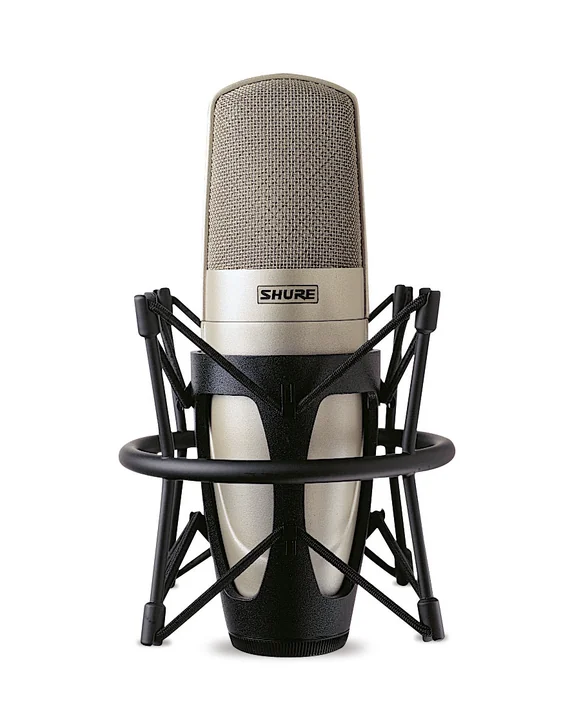
Shure KSM32
Side-address cardioid condenser (permanently biased, embossed 3/4-inch diaphragm), transformerless, with pad and low-frequency filter
Approximate Some readings for this mic are uncertain; see the graphs.
- Type
- Condenser
- Pattern
- Cardioid
- Sensitivity
- −36 dBV/Pa
- Self-noise
- 13 dB(A)
- Max SPL
- 139 dB SPL
- Impedance
- 150 Ω
- Rated range
- 20 – 20k Hz
Frequency response: from the user guide, p. 8. Figure 4, "Typical frequency response"; relative dB. Room and smoothing not stated.
Dashed: outside the rated range, or simulated (other angles and distances). Hover or tap the graphs for values.
Polar pattern
Polar pattern: from the user guide, p. 8. Figure 5, "Typical polar patterns": two plots, 125 Hz to 1 kHz and 2500 Hz to 15 kHz; 0° at the bottom, rings every 5 dB from -20 dB to +5 dB (centre -25 dB). Measuring conditions not stated. Approximate reading error up to about 1 dB.
All specs
| From the user guide | ||
|---|---|---|
| Capsule | 3/4-inch embossed, high-compliance diaphragm, 2.5 µm gold-layered Mylar. Page 3: "permanently-biased 3/4-inch diaphragm"; "Ultra-thin, 2.5 µm, gold-layered, low mass, Mylar diaphragm". | p. 3 |
| Sensitivity | −36 dBV/Pa (16 mV/Pa), typical, 1 kHz. "-36 dBV/Pa (16 mV)". | p. 7 |
| Self-noise | 13 dB(A), typical, equivalent SPL, A-weighted, IEC 651 | |
| Max SPL | 139 dB SPL, 1 kHz, 2500 ohm load; also 133 dB SPL, 1000 ohm load; also 154 dB SPL, 2500 ohm load, attenuator on; also 148 dB SPL, 1000 ohm load, attenuator on. "139 (154) dB" for 2500 ohm and "133 (148) dB" for 1000 ohm, the figures in brackets with the attenuator on. The 2010 spec sheet prints the second load as "1500 ohms" (the guide and both dynamic-range rows say 1000 ohm). | |
| Signal-to-noise ratio | 81 dB, re 94 dB SPL, A-weighted | |
| Dynamic range | 126 dB, 2500 ohm load; also 119 dB, 1000 ohm load | |
| Output impedance | 150 ohm, actual | |
| Rated load impedance | 1000 ohm, recommended minimum. "Shure recommends a load impedance of at least 1000 Ω." | p. 6 |
| Rated frequency range | 20 Hz to 20 kHz | p. 7 |
| Powering | phantom 48 V DC ±4 V (IEC-268-15/DIN 45 596). Page 5 adds that it works "with slightly decreased headroom and sensitivity with supplies as low as 11 Vdc". | |
| Current draw | 4.65 mA, typical, at 48 V | |
| Low cut | flat, 6 dB/octave below 115 Hz, 18 dB/octave below 80 Hz. Specifications: "flat; -6 db/octave below 115 Hz; -18 dB/octave below 80 Hz". The text on page 5 calls the steeper setting "a 15 dB-per-octave cutoff at 80 Hz"; Figure 2 there draws both settings. | |
| Pad | −15 dB. "0 or -15 dB attenuation". | |
| Connector | XLR-3 male. Implied: "a cable terminated with XLR connectors at each end"; positive pins 2 and 3. | p. 5 |
| Weight | 490 g | p. 7 |
| Dimensions | 55.9 × 187 mm. "55.9 mm (2.20 in.) maximum body diameter, 187 mm (7.37 in.) long": diameter, length. | |
| Supplied accessories | A32SM ShureLock rubber-isolated shock mount (SL only); A32VB velveteen pouch. Furnished accessories. Page 4: the KSM32/SL comes with an aluminium case, shock mount, swivel mount and pouch; the KSM32/CG (charcoal grey) with the swivel mount and a padded bag. | p. 9 |
| Output clipping level | +9 dBV into 2500 ohm, +3 dBV into 1000 ohm (20 Hz-20 kHz, THD < 1%) | p. 7 |
| Total harmonic distortion | <0.08% for a 120 dB equivalent SPL input, 2500 ohm load | |
| Common mode rejection | ≥50 dB, 20 Hz to 20 kHz | |
| High-level operation | With the pad on and a load of 5500 ohm or more: up to 160 dB SPL and +15 dBV output | p. 6 |
| Electronics | Class A, transformerless preamplifier; internal shock mount; three-layer mesh grille as pop filter | p. 3 |
| Models | KSM32/SL champagne finish; KSM32/CG charcoal grey | p. 4 |
| Optional accessories | PS-6 Popper Stopper pop screen; A32M ShureLock swivel adapter; A32SC aluminium case; A32ZB padded bag | p. 9 |
| Applications (Shure) | Voice; close-miking acoustic instruments (piano, guitar, violins, drums, percussion); brass and woodwind; double bass and kick drum; drum overheads; orchestras, choirs, wind ensembles; room ambience | p. 4 |
Documents
- KSM32 Cardioid Condenser Microphone, user guide (27C3044 Rev. 6)
- KSM32 Side-address Cardioid Condenser Microphone, Product Specifications
Copies kept by Mic Archive, because manufacturers move and drop their documents. Each is © Shure, unchanged, with its original address.
Recommended for
Instruments whose sources name this mic, or an earlier version or variant of it.
Other mics
- AEA KU4
- AEA N22
- AEA N8
- AEA R44
- AEA R84
- AEA R88
- AEA R92
- AKG C 1000 S
- AKG C 12
- AKG C 12 VR
- AKG C 391 B
- AKG C 451 E
- AKG C 480 B ULS
- AKG C 535 EB
- AKG C214
- AKG C3000
- AKG C414 B-ULS
- AKG C414 XLII
- AKG C414 XLS
- AKG C451 B
- AKG C519 M
- AKG C636
- AKG D 12
- AKG D 20 B
- AKG D112
- AKG D40
- AKG D5
- AKG D7
- AKG P170
- AKG P220
- AKG P420
- Aston Origin
- Aston Spirit
- Aston Starlight
- Audio-Technica AE2500
- Audio-Technica AE4100
- Audio-Technica AE5100
- Audio-Technica AT2010
- Audio-Technica AT2020
- Audio-Technica AT2021
- Audio-Technica AT2031
- Audio-Technica AT2035
- Audio-Technica AT2040
- Audio-Technica AT2050
- Audio-Technica AT4021
- Audio-Technica AT4022
- Audio-Technica AT4033/CL
- Audio-Technica AT4040
- Audio-Technica AT4041
- Audio-Technica AT4047/SV
- Audio-Technica AT4050
- Audio-Technica AT4051b
- Audio-Technica AT4053b
- Audio-Technica AT4060
- Audio-Technica AT4080
- Audio-Technica AT5045
- Audio-Technica AT831b
- Audio-Technica ATM230
- Audio-Technica ATM25
- Audio-Technica ATM350
- Audio-Technica ATM450
- Audio-Technica ATM650
- Audio-Technica ES933
- Audio-Technica PRO 35
- Audio-Technica PRO 45
- Audio-Technica U853
- Audix ADX20i
- Audix D2
- Audix D4
- Audix D6
- Audix f6
- Audix FireBall
- Audix i5
- Audix MB5050
- Audix MB8450
- Audix OM5
- Audix OM7
- Austrian Audio OC16
- Austrian Audio OC18
- Austrian Audio OC818
- Austrian Audio OD303
- Avantone CK-1
- Avantone CV-28
- Behringer C-2
- Behringer ECM8000
- Behringer XM8500
- beyerdynamic M 130
- beyerdynamic M 160
- beyerdynamic M 201
- beyerdynamic M 260
- beyerdynamic M 380
- beyerdynamic M 422
- beyerdynamic M 69 TG
- beyerdynamic M 88 TG
- beyerdynamic M 99
- beyerdynamic MC 740
- beyerdynamic MC 834
- beyerdynamic MC 930
- beyerdynamic Opus 87
- beyerdynamic TG D71
- beyerdynamic TG V70d
- Blue Baby Bottle
- Blue Cactus
- Blue Hummingbird
- Blue Kiwi
- Blue Yeti
- Bluebird
- CAD D80
- CAD Equitek E100S
- CAD M179
- Cascade Fat Head II
- Coles 4038
- Countryman E6
- Crown GLM-100
- DPA 2011
- DPA 2012
- DPA 2015
- DPA 4006-TL
- DPA 4006A
- DPA 4011A
- DPA 4015A
- DPA 4017B
- DPA 4018A
- DPA 4041-SP
- DPA 4055
- DPA 4060
- DPA 4061
- DPA 4066
- DPA 4088
- DPA 4097
- DPA 4098
- DPA 4099
- DPA d:facto 4018V
- Earthworks DM20
- Earthworks M30
- Earthworks QTC1
- Earthworks QTC40
- Earthworks SR25
- Earthworks SR40V
- Earthworks SR69
- Earthworks TC20
- Electro-Voice 635A
- Electro-Voice N/D468
- Electro-Voice N/D767a
- Electro-Voice N/D868
- Electro-Voice ND44
- Electro-Voice ND46
- Electro-Voice ND66
- Electro-Voice ND68
- Electro-Voice ND76
- Electro-Voice ND76S
- Electro-Voice ND86
- Electro-Voice ND96
- Electro-Voice RE15
- Electro-Voice RE16
- Electro-Voice RE20
- Electro-Voice RE27N/D
- Electro-Voice RE320
- Electro-Voice RE410
- Electro-Voice RE50/B
- Electro-Voice RE500
- Electro-Voice RE510
- Electro-Voice RE90H
- Electro-Voice RE92H
- FLEA47
- Galaxy Audio CBM-5
- Heil PR 22
- Heil PR 30
- Heil PR 35
- Heil PR 40
- Josephson C42
- Josephson e22S
- Lawson L47MP Mk II
- LEWITT LCT 440 PURE
- LEWITT LCT 540 S
- Line Audio CM4
- Microtech Gefell M 221
- Microtech Gefell M 300
- Microtech Gefell M 930
- Microtech Gefell M 940
- Mojave MA-200
- Mojave MA-201fet
- Mojave MA-300
- Mojave MA-50
- MXL 603S
- MXL 770
- MXL 990
- MXL 993
- MXL V67G
- Neumann BCM 104
- Neumann BCM 705
- Neumann KM 131
- Neumann KM 140
- Neumann KM 183
- Neumann KM 184
- Neumann KM 184 D
- Neumann KM 185
- Neumann KM 84
- Neumann KM 85
- Neumann KM 86
- Neumann KMR 81 i
- Neumann KMS 104
- Neumann KMS 105
- Neumann M 147 Tube
- Neumann M 149 Tube
- Neumann M 49 V
- Neumann M 50
- Neumann MCM KK 14
- Neumann TLM 102
- Neumann TLM 103
- Neumann TLM 107
- Neumann TLM 127
- Neumann TLM 170 R
- Neumann TLM 193
- Neumann TLM 49
- Neumann TLM 50
- Neumann TLM 67
- Neumann U 47
- Neumann U 47 fet
- Neumann U 67
- Neumann U 87 (U 87 i)
- Neumann U 87 Ai
- Neumann U 89 i
- Neumann USM 69 i
- Oktava MK-012
- Pearl TL 44
- RCA 44-BX
- RCA 77-DX
- Royer R-10
- Royer R-101
- Royer R-121
- Royer R-122
- Royer R-122 MKII
- Royer SF-12
- Royer SF-2
- Royer SF-24
- RØDE Broadcaster
- RØDE K2
- RØDE M3
- RØDE M5
- RØDE NT-SF1
- RØDE NT-USB
- RØDE NT1
- RØDE NT1 Signature Series
- RØDE NT1-A
- RØDE NT1000
- RØDE NT2-A
- RØDE NT3
- RØDE NT4
- RØDE NT5
- RØDE NT55
- RØDE NT6
- RØDE NTG3
- RØDE NTG4+
- RØDE NTG5
- RØDE NTR
- RØDE Podcaster
- RØDE PodMic
- RØDE Procaster
- RØDE TF-5
- RØDE VideoMic NTG
- Samson C02
- Sanken CO-100K
- Sanken COS-11D
- Schoeps CCM 21
- Schoeps CCM 4
- Schoeps CMIT 5
- Schoeps MK 2
- Schoeps MK 21
- Schoeps MK 22
- Schoeps MK 2S
- Schoeps MK 4
- Schoeps MK 41
- Schoeps MK 4V
- Schoeps MK 5
- Schoeps MK 8
- Schoeps V4 U
- sE RNR1
- sE V Beat
- sE V Kick
- sE V7
- sE V7 X
- sE VR1
- sE VR2
- sE X1 S
- sE4400
- sE7
- sE8
- Sennheiser e 602-II
- Sennheiser e 604
- Sennheiser e 608
- Sennheiser e 609 silver
- Sennheiser e 614
- Sennheiser e 835
- Sennheiser e 840
- Sennheiser e 845
- Sennheiser e 865
- Sennheiser e 901
- Sennheiser e 902
- Sennheiser e 904
- Sennheiser e 906
- Sennheiser e 908 B
- Sennheiser e 914
- Sennheiser e 935
- Sennheiser e 945
- Sennheiser e 965
- Sennheiser MD 409
- Sennheiser MD 421
- Sennheiser MD 421-II
- Sennheiser MD 431 II
- Sennheiser MD 441 U
- Sennheiser ME 66
- Sennheiser MK 4
- Sennheiser MK 8
- Sennheiser MKE 600
- Sennheiser MKH 20 P48
- Sennheiser MKH 30 P48
- Sennheiser MKH 40 P48
- Sennheiser MKH 416
- Sennheiser MKH 50 P48
- Sennheiser MKH 60
- Sennheiser MKH 70
- Sennheiser MKH 800
- Sennheiser MKH 8020
- Sennheiser MKH 8040
- Sennheiser MKH 8050
- Sennheiser MKH 8060
- Sennheiser MKH 8090
- Shure 520DX "Green Bullet"
- Shure 55SH Series II
- Shure Beta 181
- Shure Beta 27
- Shure Beta 52A
- Shure Beta 53
- Shure Beta 54
- Shure Beta 56A
- Shure Beta 57A
- Shure Beta 58A
- Shure Beta 87A
- Shure Beta 91A
- Shure Beta 98/S
- Shure Beta 98AMP
- Shure Beta 98D/S
- Shure Beta 98H/C
- Shure CVO-B/C
- Shure KSM109
- Shure KSM137
- Shure KSM141
- Shure KSM27
- Shure KSM313
- Shure KSM353
- Shure KSM42
- Shure KSM44
- Shure KSM44A
- Shure KSM8 Dualdyne
- Shure KSM9
- Shure MV7
- Shure MX183
- Shure MX185
- Shure MX202
- Shure PG52
- Shure PG57
- Shure PG81
- Shure PGA181
- Shure PGA27
- Shure PGA48
- Shure PGA52
- Shure PGA58
- Shure PGA81
- Shure PGA98H
- Shure SM137
- Shure SM27
- Shure SM4
- Shure SM48
- Shure SM57
- Shure SM58
- Shure SM63
- Shure SM7B
- Shure SM7dB
- Shure SM81
- Shure SM84
- Shure SM86
- Shure SM89
- Shure SM94
- Shure SM98
- Shure Super 55
- Shure VP88
- Sontronics APOLLO 2
- Sontronics DELTA 2
- Sontronics SIGMA 2
- Sontronics SOLO
- Sontronics STC-2
- Sony C-100
- Sony C-37A
- Sony C-38B
- Sony C-800G
- Studio Projects C4
- Superlux PRA383
- Superlux R102
- t.bone Ovid System CC 100
- Telefunken C12
- Telefunken ELA M 251E
- Telefunken ELA M 260
- Telefunken M60 FET
- TELEFUNKEN M80
- TELEFUNKEN M81
- TELEFUNKEN M82
- Telefunken TF11
- Telefunken TF51
- Warm Audio WA-14
- Warm Audio WA-19
- Warm Audio WA-251
- Warm Audio WA-44
- Warm Audio WA-47
- Warm Audio WA-47jr
- Warm Audio WA-8000
- Warm Audio WA-84
- Warm Audio WA-87 R2