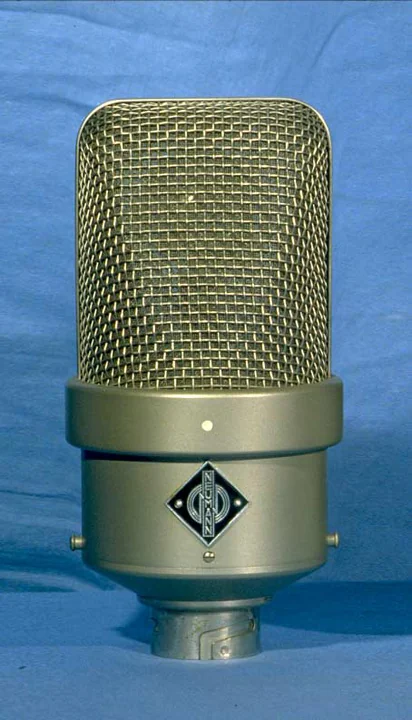
Neumann
Neumann M 50
Tube condenser, omni: a small pressure capsule set flush in a perspex sphere, so it grows directional at high frequencies; the Decca tree mic. Made 1951 to 1971, discontinued
Approximate Some readings for this mic are uncertain; see the graphs.
- Type
- Condenser
- Pattern
- Omni
- Sensitivity
- −36.5 dBV/Pa computed
- Max SPL
- 126 dB SPL
- Impedance
- 200 Ω
- Rated range
- 40 – 16k Hz
Frequency response: from the catalog, p. 7. M 50 c, as printed in the 1964 brochure: no measuring conditions stated (free field presumably; the brochure says the response rises at the high end by about 5 dB and is almost linear in a diffuse field).
Dashed: outside the rated range, or simulated (other angles and distances). Hover or tap the graphs for values.
Polar pattern
Polar pattern: from the catalog, p. 8. M 50 c, 1964 brochure; no measuring conditions stated. Rings every 5 dB down to -20 dB. Both halves drawn; the two are averaged here. Approximate reading error up to about 1 dB; some frequencies are identified by reasoning, not by the legend: 10k Hz, 15k Hz.
All specs
| From the catalog | ||
|---|---|---|
| Capsule | Small pressure capsule with a metal diaphragm, mounted flush in a perspex sphere. "equipped with a metal diaphragm and mounted inside a perspex sphere". The history sheet: originally a highly stretched aluminium diaphragm, later gold-sputtered polyester foil, 10 µm from the backplate. | p. 3 |
| Sensitivity | −36.5 dBV/Pa (15 mV/Pa), into 1000 ohm; also −40 dBV/Pa, M 50 b, 1960 manual (1.0 mV per dyne/cm²). Not stated by the manufacturer: From 1.5 mV/µbar = 15 mV/Pa: 20·log10(0.015). | p. 6 |
| Max SPL | 126 dB SPL, 0.5% distortion at 40 Hz, 1 kHz and 5 kHz; "≧ 126 dB"; also 114 dB SPL, M 50 b, 1960 manual: THD less than 0.6% (40-15,000 cps) up to 114 dB. "Max. sound pressure for .5% distortion at 40 cps, 1 kcps and 5 kcps ≧ 126 dB (dB above 2·10⁻⁴ µb)", i.e. re 20 µPa. | |
| Output impedance | 200 ohm, ±20%; 50 ohm with two links changed on the output transformer; also 50 ohm, strapped for 50 ohm (output 6 dB lower; marked with a red dot). "Electrical source resistance 200 (50) Ω ± 20 %"; p. 3 explains the 50 ohm strapping. | |
| Rated load impedance | 1000 ohm, minimum; 250 ohm when strapped for 50 ohm. "Electrical load resistance ≧ 1 000 (250) Ω". | |
| Rated frequency range | 40 Hz to 16 kHz; also [40, 15000], M 50 b, 1960 manual: "Useable range of frequencies". "Frequency response 40 ... 16 000 cps". P. 3: in a diffuse field "an almost linear frequency response from 40 to 15 000 cps". | |
| Powering | external tube supply: NN 48 b mains unit (4 V heater, 116 V plate), N 52 t plug-in unit or BB 50 battery unit. Accessories (p. 3, p. 4). Operating voltages from the 1960 manual (p. 1): "4 volts D.C. heater; 116 volts D.C. plate". | p. 3 |
| Connector | 8-pin Tuchel plug with bayonet locking. Supplied as M 250 c with RF-proof 7-pole standard couplings (Tuchel contact system). | p. 2 |
| Weight | 800 g. ".8 kg". | p. 6 |
| Dimensions | 163 × 80 mm. Length 163 mm, diameter 80 mm. | |
| Tube | Telefunken AC 701 k triode, as anode amplifier into an astatically wound transformer | |
| Capacitance of capsule | approx. 75 pF | |
| Total noise voltage | ≦ 16 µV | |
| Weighted noise voltage (DIN 45 405) | ≦ 7 µV | |
| Equivalent loudness (DIN 45 405) | ≦ 28 dB (re 2·10⁻⁴ µbar) | |
| Gain of microphone amplifier at 1 kHz | approx. -1 dB | |
| Response | Rises evenly by about 5 dB towards high frequencies without becoming too directional; almost linear from 40 Hz to 15 kHz in a diffuse field | p. 3 |
| Identification | White dot above the Neumann badge (the M 49 has a red one); same body as the M 49 | p. 2 |
| Use | Orchestras in acoustically favourable rooms with one microphone; spot mic for woodwind, brass and strings | |
| Accessories | NN 48 b power supply, N 52 t plug-in power supply (up to ten in an S 167 frame), BB 50 battery unit, C 26 / C 28 s cables (10 m), MZ 49 suspension | p. 3 |
| From the m50v manual | ||
| Versions | M 50 (1951), M 50 b (documents of 1959-60), M 50 c (1964 brochure); Neumann's re-edition is the M 50 V | p. 8 |
| From the product page | ||
| Decca tree | The M 50 "was instrumental in developing the Decca tree recording technique" | |
Documents
- Condenser microphones M 49 c and M 50 c (brochure M 49 - M 50 - 910-02-01, English)
- Operating instructions for condenser microphones M 49 b / M 50 b and accessories (April 1960, English)
- M 50 - The Historic Omni Directional (Neumann historical collection, "General information about the M 50")
- M 49 V / M 50 V operating manual, Publ. 02/25 (592832/A02)
- M 50 - Condenser Microphone (omni), neumann.com historical products
Copies kept by Mic Archive, because manufacturers move and drop their documents. Each is © Neumann, unchanged, with its original address.
Recommended for
Instruments whose sources name this mic, or an earlier version or variant of it.
Other mics
- AEA KU4
- AEA N22
- AEA N8
- AEA R44
- AEA R84
- AEA R88
- AEA R92
- AKG C 1000 S
- AKG C 12
- AKG C 12 VR
- AKG C 391 B
- AKG C 451 E
- AKG C 480 B ULS
- AKG C 535 EB
- AKG C214
- AKG C3000
- AKG C414 B-ULS
- AKG C414 XLII
- AKG C414 XLS
- AKG C451 B
- AKG C519 M
- AKG C636
- AKG D 12
- AKG D 20 B
- AKG D112
- AKG D40
- AKG D5
- AKG D7
- AKG P170
- AKG P220
- AKG P420
- Aston Origin
- Aston Spirit
- Aston Starlight
- Audio-Technica AE2500
- Audio-Technica AE4100
- Audio-Technica AE5100
- Audio-Technica AT2010
- Audio-Technica AT2020
- Audio-Technica AT2021
- Audio-Technica AT2031
- Audio-Technica AT2035
- Audio-Technica AT2040
- Audio-Technica AT2050
- Audio-Technica AT4021
- Audio-Technica AT4022
- Audio-Technica AT4033/CL
- Audio-Technica AT4040
- Audio-Technica AT4041
- Audio-Technica AT4047/SV
- Audio-Technica AT4050
- Audio-Technica AT4051b
- Audio-Technica AT4053b
- Audio-Technica AT4060
- Audio-Technica AT4080
- Audio-Technica AT5045
- Audio-Technica AT831b
- Audio-Technica ATM230
- Audio-Technica ATM25
- Audio-Technica ATM350
- Audio-Technica ATM450
- Audio-Technica ATM650
- Audio-Technica ES933
- Audio-Technica PRO 35
- Audio-Technica PRO 45
- Audio-Technica U853
- Audix ADX20i
- Audix D2
- Audix D4
- Audix D6
- Audix f6
- Audix FireBall
- Audix i5
- Audix MB5050
- Audix MB8450
- Audix OM5
- Audix OM7
- Austrian Audio OC16
- Austrian Audio OC18
- Austrian Audio OC818
- Austrian Audio OD303
- Avantone CK-1
- Avantone CV-28
- Behringer C-2
- Behringer ECM8000
- Behringer XM8500
- beyerdynamic M 130
- beyerdynamic M 160
- beyerdynamic M 201
- beyerdynamic M 260
- beyerdynamic M 380
- beyerdynamic M 422
- beyerdynamic M 69 TG
- beyerdynamic M 88 TG
- beyerdynamic M 99
- beyerdynamic MC 740
- beyerdynamic MC 834
- beyerdynamic MC 930
- beyerdynamic Opus 87
- beyerdynamic TG D71
- beyerdynamic TG V70d
- Blue Baby Bottle
- Blue Cactus
- Blue Hummingbird
- Blue Kiwi
- Blue Yeti
- Bluebird
- CAD D80
- CAD Equitek E100S
- CAD M179
- Cascade Fat Head II
- Coles 4038
- Countryman E6
- Crown GLM-100
- DPA 2011
- DPA 2012
- DPA 2015
- DPA 4006-TL
- DPA 4006A
- DPA 4011A
- DPA 4015A
- DPA 4017B
- DPA 4018A
- DPA 4041-SP
- DPA 4055
- DPA 4060
- DPA 4061
- DPA 4066
- DPA 4088
- DPA 4097
- DPA 4098
- DPA 4099
- DPA d:facto 4018V
- Earthworks DM20
- Earthworks M30
- Earthworks QTC1
- Earthworks QTC40
- Earthworks SR25
- Earthworks SR40V
- Earthworks SR69
- Earthworks TC20
- Electro-Voice 635A
- Electro-Voice N/D468
- Electro-Voice N/D767a
- Electro-Voice N/D868
- Electro-Voice ND44
- Electro-Voice ND46
- Electro-Voice ND66
- Electro-Voice ND68
- Electro-Voice ND76
- Electro-Voice ND76S
- Electro-Voice ND86
- Electro-Voice ND96
- Electro-Voice RE15
- Electro-Voice RE16
- Electro-Voice RE20
- Electro-Voice RE27N/D
- Electro-Voice RE320
- Electro-Voice RE410
- Electro-Voice RE50/B
- Electro-Voice RE500
- Electro-Voice RE510
- Electro-Voice RE90H
- Electro-Voice RE92H
- FLEA47
- Galaxy Audio CBM-5
- Heil PR 22
- Heil PR 30
- Heil PR 35
- Heil PR 40
- Josephson C42
- Josephson e22S
- Lawson L47MP Mk II
- LEWITT LCT 440 PURE
- LEWITT LCT 540 S
- Line Audio CM4
- Microtech Gefell M 221
- Microtech Gefell M 300
- Microtech Gefell M 930
- Microtech Gefell M 940
- Mojave MA-200
- Mojave MA-201fet
- Mojave MA-300
- Mojave MA-50
- MXL 603S
- MXL 770
- MXL 990
- MXL 993
- MXL V67G
- Neumann BCM 104
- Neumann BCM 705
- Neumann KM 131
- Neumann KM 140
- Neumann KM 183
- Neumann KM 184
- Neumann KM 184 D
- Neumann KM 185
- Neumann KM 84
- Neumann KM 85
- Neumann KM 86
- Neumann KMR 81 i
- Neumann KMS 104
- Neumann KMS 105
- Neumann M 147 Tube
- Neumann M 149 Tube
- Neumann M 49 V
- Neumann MCM KK 14
- Neumann TLM 102
- Neumann TLM 103
- Neumann TLM 107
- Neumann TLM 127
- Neumann TLM 170 R
- Neumann TLM 193
- Neumann TLM 49
- Neumann TLM 50
- Neumann TLM 67
- Neumann U 47
- Neumann U 47 fet
- Neumann U 67
- Neumann U 87 (U 87 i)
- Neumann U 87 Ai
- Neumann U 89 i
- Neumann USM 69 i
- Oktava MK-012
- Pearl TL 44
- RCA 44-BX
- RCA 77-DX
- Royer R-10
- Royer R-101
- Royer R-121
- Royer R-122
- Royer R-122 MKII
- Royer SF-12
- Royer SF-2
- Royer SF-24
- RØDE Broadcaster
- RØDE K2
- RØDE M3
- RØDE M5
- RØDE NT-SF1
- RØDE NT-USB
- RØDE NT1
- RØDE NT1 Signature Series
- RØDE NT1-A
- RØDE NT1000
- RØDE NT2-A
- RØDE NT3
- RØDE NT4
- RØDE NT5
- RØDE NT55
- RØDE NT6
- RØDE NTG3
- RØDE NTG4+
- RØDE NTG5
- RØDE NTR
- RØDE Podcaster
- RØDE PodMic
- RØDE Procaster
- RØDE TF-5
- RØDE VideoMic NTG
- Samson C02
- Sanken CO-100K
- Sanken COS-11D
- Schoeps CCM 21
- Schoeps CCM 4
- Schoeps CMIT 5
- Schoeps MK 2
- Schoeps MK 21
- Schoeps MK 22
- Schoeps MK 2S
- Schoeps MK 4
- Schoeps MK 41
- Schoeps MK 4V
- Schoeps MK 5
- Schoeps MK 8
- Schoeps V4 U
- sE RNR1
- sE V Beat
- sE V Kick
- sE V7
- sE V7 X
- sE VR1
- sE VR2
- sE X1 S
- sE4400
- sE7
- sE8
- Sennheiser e 602-II
- Sennheiser e 604
- Sennheiser e 608
- Sennheiser e 609 silver
- Sennheiser e 614
- Sennheiser e 835
- Sennheiser e 840
- Sennheiser e 845
- Sennheiser e 865
- Sennheiser e 901
- Sennheiser e 902
- Sennheiser e 904
- Sennheiser e 906
- Sennheiser e 908 B
- Sennheiser e 914
- Sennheiser e 935
- Sennheiser e 945
- Sennheiser e 965
- Sennheiser MD 409
- Sennheiser MD 421
- Sennheiser MD 421-II
- Sennheiser MD 431 II
- Sennheiser MD 441 U
- Sennheiser ME 66
- Sennheiser MK 4
- Sennheiser MK 8
- Sennheiser MKE 600
- Sennheiser MKH 20 P48
- Sennheiser MKH 30 P48
- Sennheiser MKH 40 P48
- Sennheiser MKH 416
- Sennheiser MKH 50 P48
- Sennheiser MKH 60
- Sennheiser MKH 70
- Sennheiser MKH 800
- Sennheiser MKH 8020
- Sennheiser MKH 8040
- Sennheiser MKH 8050
- Sennheiser MKH 8060
- Sennheiser MKH 8090
- Shure 520DX "Green Bullet"
- Shure 55SH Series II
- Shure Beta 181
- Shure Beta 27
- Shure Beta 52A
- Shure Beta 53
- Shure Beta 54
- Shure Beta 56A
- Shure Beta 57A
- Shure Beta 58A
- Shure Beta 87A
- Shure Beta 91A
- Shure Beta 98/S
- Shure Beta 98AMP
- Shure Beta 98D/S
- Shure Beta 98H/C
- Shure CVO-B/C
- Shure KSM109
- Shure KSM137
- Shure KSM141
- Shure KSM27
- Shure KSM313
- Shure KSM32
- Shure KSM353
- Shure KSM42
- Shure KSM44
- Shure KSM44A
- Shure KSM8 Dualdyne
- Shure KSM9
- Shure MV7
- Shure MX183
- Shure MX185
- Shure MX202
- Shure PG52
- Shure PG57
- Shure PG81
- Shure PGA181
- Shure PGA27
- Shure PGA48
- Shure PGA52
- Shure PGA58
- Shure PGA81
- Shure PGA98H
- Shure SM137
- Shure SM27
- Shure SM4
- Shure SM48
- Shure SM57
- Shure SM58
- Shure SM63
- Shure SM7B
- Shure SM7dB
- Shure SM81
- Shure SM84
- Shure SM86
- Shure SM89
- Shure SM94
- Shure SM98
- Shure Super 55
- Shure VP88
- Sontronics APOLLO 2
- Sontronics DELTA 2
- Sontronics SIGMA 2
- Sontronics SOLO
- Sontronics STC-2
- Sony C-100
- Sony C-37A
- Sony C-38B
- Sony C-800G
- Studio Projects C4
- Superlux PRA383
- Superlux R102
- t.bone Ovid System CC 100
- Telefunken C12
- Telefunken ELA M 251E
- Telefunken ELA M 260
- Telefunken M60 FET
- TELEFUNKEN M80
- TELEFUNKEN M81
- TELEFUNKEN M82
- Telefunken TF11
- Telefunken TF51
- Warm Audio WA-14
- Warm Audio WA-19
- Warm Audio WA-251
- Warm Audio WA-44
- Warm Audio WA-47
- Warm Audio WA-47jr
- Warm Audio WA-8000
- Warm Audio WA-84
- Warm Audio WA-87 R2